Softacus Jazz Application: A Maintained Middleware Platform for IBM ELM Extensions
IBM Engineering Lifecycle Management environments rarely stay simple for long. Requirements, work items, tests, global configurations, users, reports and external systems all become part of the same engineering landscape. Teams then add browser widgets, automation jobs, import/export flows, synchronization services and workflow-specific extensions on top of that landscape.
The technical challenge is not only building one useful extension. The challenge is building many of them without repeating the same integration work every time.
Every custom module that communicates with IBM ELM must deal with application URLs, authentication, Jazz sessions, OSLC-style resources, configuration context, request headers, domain-specific APIs, error handling and long-term compatibility. If each widget or automation solves these concerns independently, the result can become difficult to maintain and harder to upgrade.
Softacus Jazz Application (SJA) addresses this problem by providing a maintained middleware and extension platform for IBM Jazz/ELM environments. It gives widgets, solution modules, automation jobs and external consumers a shared server-side foundation for communicating with IBM ELM applications in a more consistent way.
What Softacus Jazz Application is
Softacus Jazz Application is a WAR-based middleware platform positioned between consumers and IBM ELM/Jazz applications. On one side are browser widgets, automation jobs and external API consumers. On the other side are IBM ELM applications such as Requirements Management / DOORS Next, Change and Configuration Management / Engineering Workflow Management, Quality Management / Engineering Test Management, Global Configuration and Jazz Team Server.
Inside SJA, solution modules do not need to integrate with each IBM ELM application completely from scratch. They can build on a common runtime, proxy APIs and a Softacus-maintained jazz-api-sdk layer. This makes SJA more than a backend for individual widgets. It is a reusable integration foundation and delivery vehicle for modular business solutions.
The name of the article is Softacus Jazz Application. In the architecture, the API and SDK layers remain important technical concepts: they are the parts that make cross-application communication maintainable.
Why IBM ELM extensions need a maintained integration layer
IBM ELM brings together multiple lifecycle disciplines. Requirements teams work in DOORS Next. Development and change workflows often involve Engineering Workflow Management. Test planning and execution are handled in Engineering Test Management. Global Configuration helps teams reason about streams, baselines and configuration relationships across lifecycle artifacts. Jazz Team Server provides shared platform services.
That multi-application model is powerful, but it also means extensions must understand the context in which they operate. A simple workflow can touch requirements, work items, test artifacts, global configurations, users and links. Integration code may need to discover services, call the right application, preserve authentication context and respect configuration-specific headers.
SJA centralizes these recurring concerns. Instead of each custom solution module implementing its own IBM ELM communication patterns, SJA provides a common server-side layer that solution modules can reuse.
Architecture at a glance
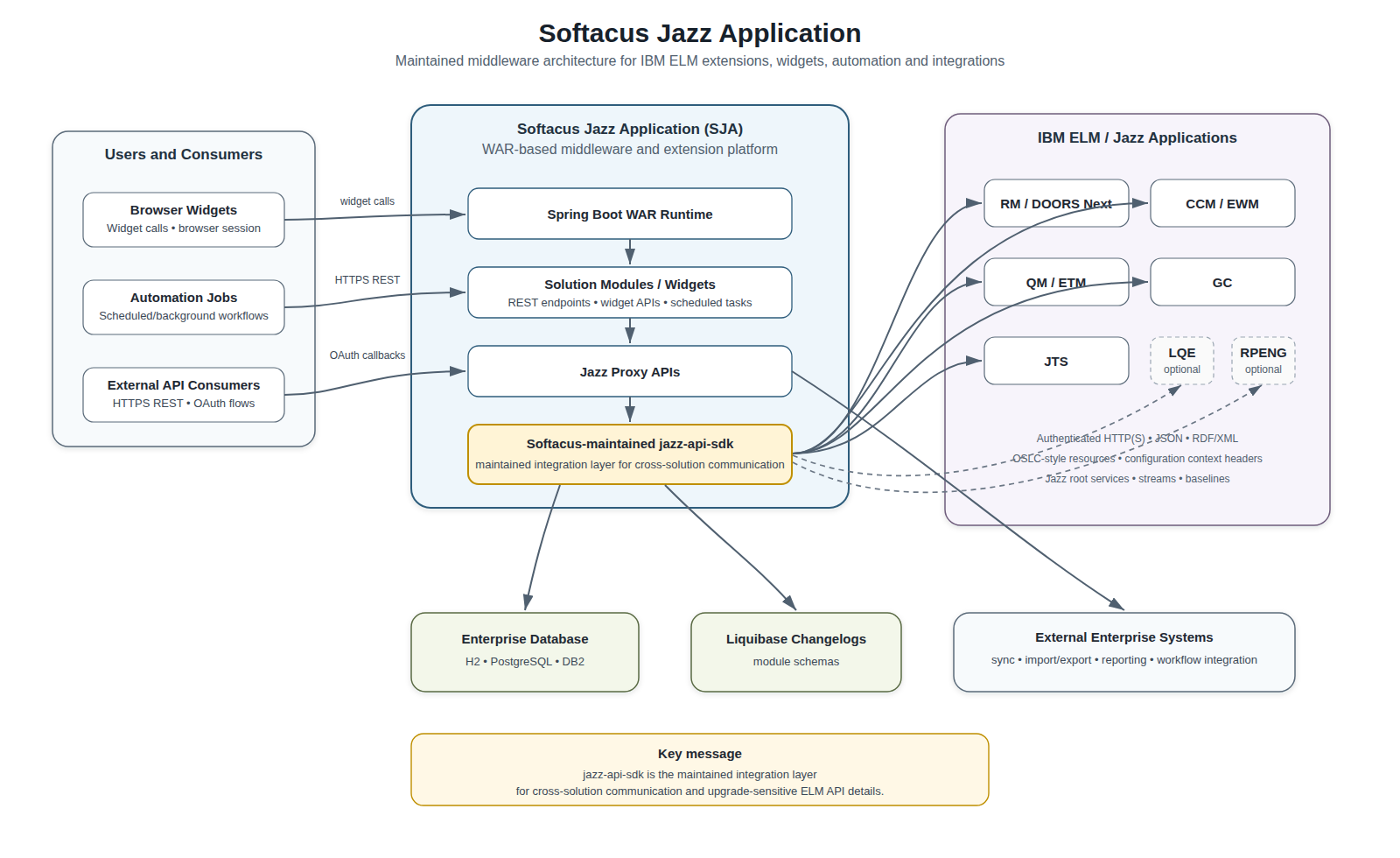
The SJA architecture can be understood in four groups.

Softacus Jazz Application provides a maintained middleware layer between IBM ELM applications, solution modules, user-facing widgets, automation jobs, enterprise databases and external systems.
First, there are users and consumers: browser widgets, automation jobs and external API consumers. They communicate with SJA through authenticated browser sessions, widget calls, OAuth-based flows or HTTPS REST calls, depending on the scenario.
Second, there is the SJA runtime. The runtime packages selected solution modules into a WAR-based application. These modules can expose REST endpoints, widget APIs, configuration screens, scheduled tasks, workflow logic and persistence needs.
Third, there is the proxy and SDK layer. Jazz Proxy APIs normalize communication patterns, while the jazz-api-sdk encapsulates IBM ELM-specific access patterns, domain models, authentication handling, configuration context and service conventions.
Fourth, there are IBM ELM/Jazz applications and enterprise systems. SJA can communicate with RM/DOORS Next, CCM/EWM, QM/ETM, GC and JTS, with optional extension toward reporting or publishing-related services where a module needs them. It can also connect selected solution modules to enterprise databases and external systems for synchronization, reporting, import/export and workflow integration.
This architecture makes the maintained SDK layer the key point of leverage. When IBM ELM integration details change, the goal is to absorb that complexity in one shared layer rather than in every individual extension.
The SDK advantage
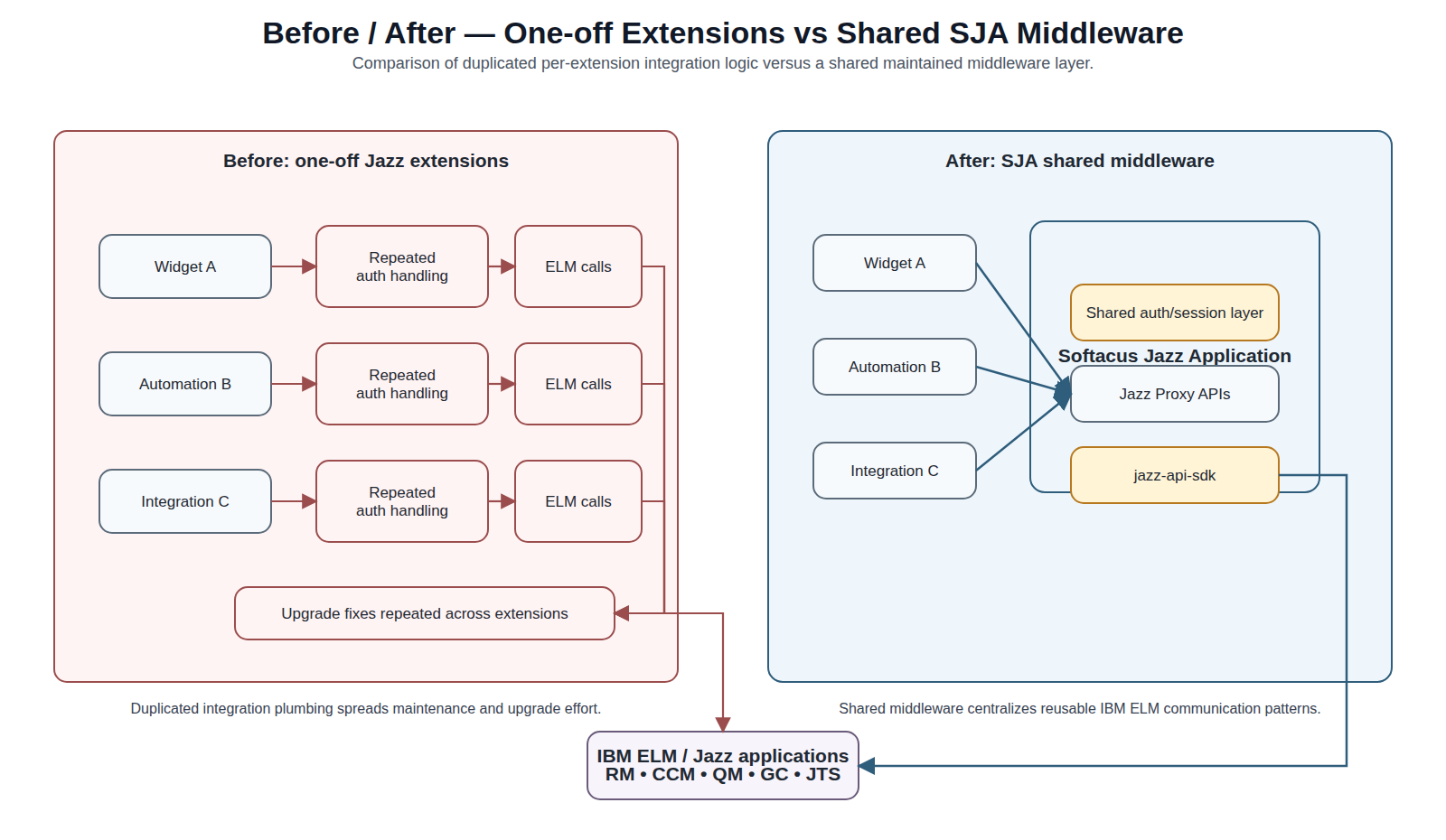
The difference between one-off extensions and SJA is easier to see when the repeated integration work is made visible. Without a shared platform, each widget, automation or integration can end up solving authentication, ELM communication and upgrade-sensitive behavior on its own. With SJA, those recurring concerns move into a common middleware layer.

SJA reduces duplicated extension plumbing by centralizing reusable IBM ELM communication patterns in a shared middleware layer.
The jazz-api-sdk is the maintained integration layer inside SJA. Its purpose is to make IBM ELM communication reusable across solution modules.
For requirements workflows, a module may need artifacts, modules, folders, views, comments, links, locks, components and configuration-aware operations. For change workflows, it may need work items, attributes, queries, comments, releases or attachments. For test workflows, it may need test cases, plans, execution records or results. For global configuration, it may need streams, baselines, child contributions or configuration lookups.
Without a shared SDK, each solution module would need to solve these patterns separately. With SJA, modules can rely on a common approach to application access, request construction, authentication context and service-level behavior.
That is the practical value of the platform: business-specific modules can focus on the workflow they are built to improve, while the SDK and proxy layer handle much of the integration plumbing.
Communication model for real IBM ELM landscapes
SJA communicates with IBM ELM applications through authenticated HTTP(S) and application-specific service calls. Depending on the operation, communication can involve JSON, RDF/XML, OSLC-style resources, configuration context headers and Jazz root service discovery.
This matters because IBM ELM environments are not just collections of isolated REST endpoints. Applications need to discover each other, understand project or component context, and operate correctly in configuration-enabled environments. Public OSLC concepts such as root services and service provider catalogs are part of the broader integration landscape that tools use to discover capabilities and connect lifecycle data.
SJA does not remove the complexity of IBM ELM. Instead, it gives Softacus and its customers a maintained place to manage that complexity consistently.
Authentication and sessions
Enterprise engineering environments usually need more than one authentication pattern. Some extensions run as part of a user-facing browser workflow. Others execute background jobs, administrative operations or server-side synchronization. SJA is designed to support both user-scoped and service-side operation patterns where configured.
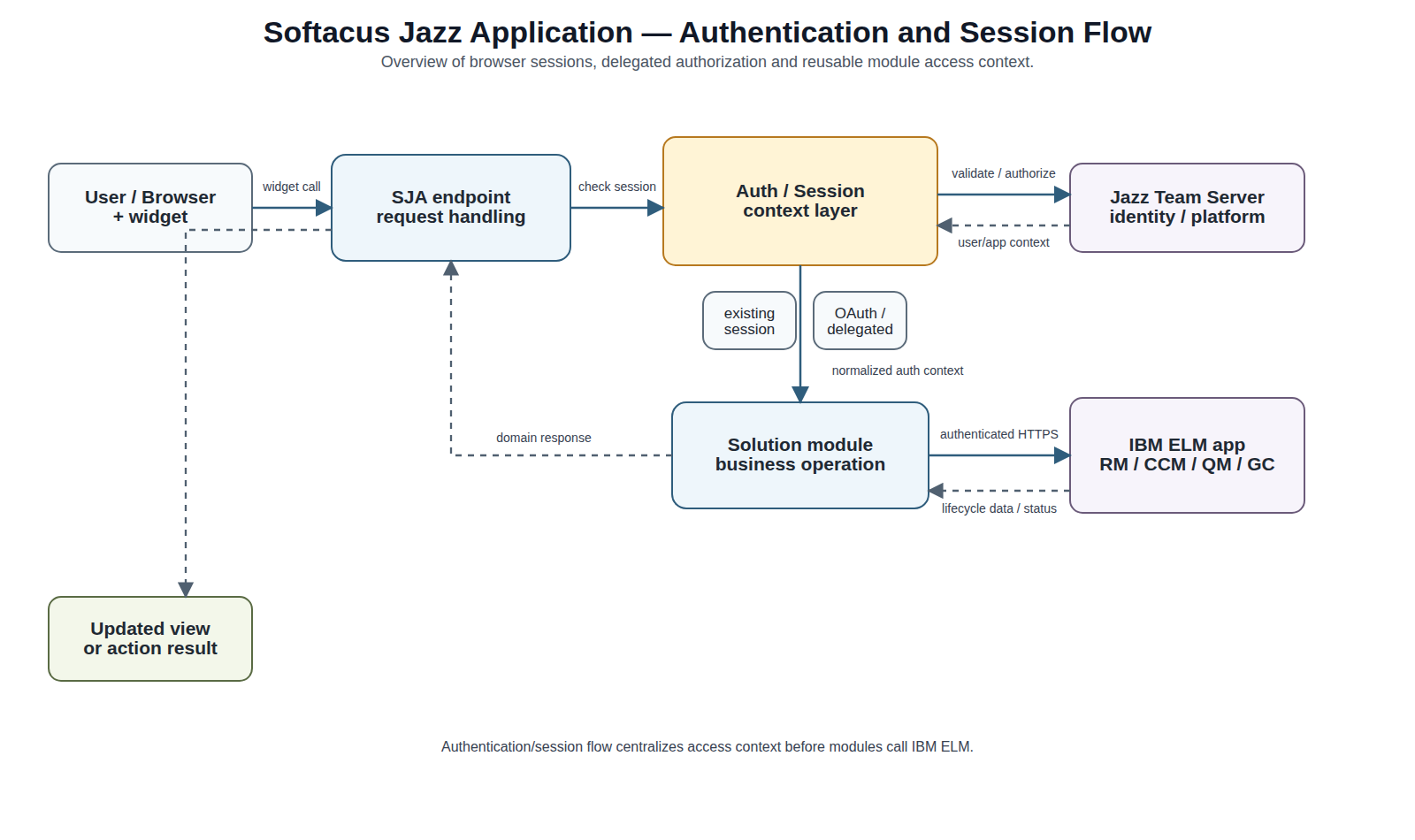
The important architectural point is that authentication and session context should be handled consistently before a solution module communicates with IBM ELM. The flow below shows the public-safe view: browser or delegated access is normalized by SJA, then reused by the module when it performs the actual ELM operation.

SJA normalizes browser or delegated access context before solution modules perform authenticated IBM ELM operations.
For public-facing communication, the important point is simple: SJA can support authenticated browser sessions, OAuth-based flows and server-side integration patterns without exposing credentials or environment-specific details in the article, diagram or documentation.
Modular solutions on one foundation
SJA is modular. Different solution modules can be packaged into the same runtime depending on deployment needs. Public-safe capability categories include filtering and search, requirements operations, export/import, reuse and versioning, synchronization, traceability and linking, metrics and reporting, access and user management, comments and collaboration, and hierarchy generation.
This model is useful for organizations that need targeted extensions but do not want a fragmented architecture. Each solution can address a specific business problem while still relying on the same maintained foundation for IBM ELM communication, authentication, persistence and runtime conventions.
Deployment and enterprise fit
SJA is normally deployed as a WAR application. Depending on the customer environment, it can be deployed close to IBM Jazz applications or as a standalone server communicating with IBM ELM over HTTP(S).
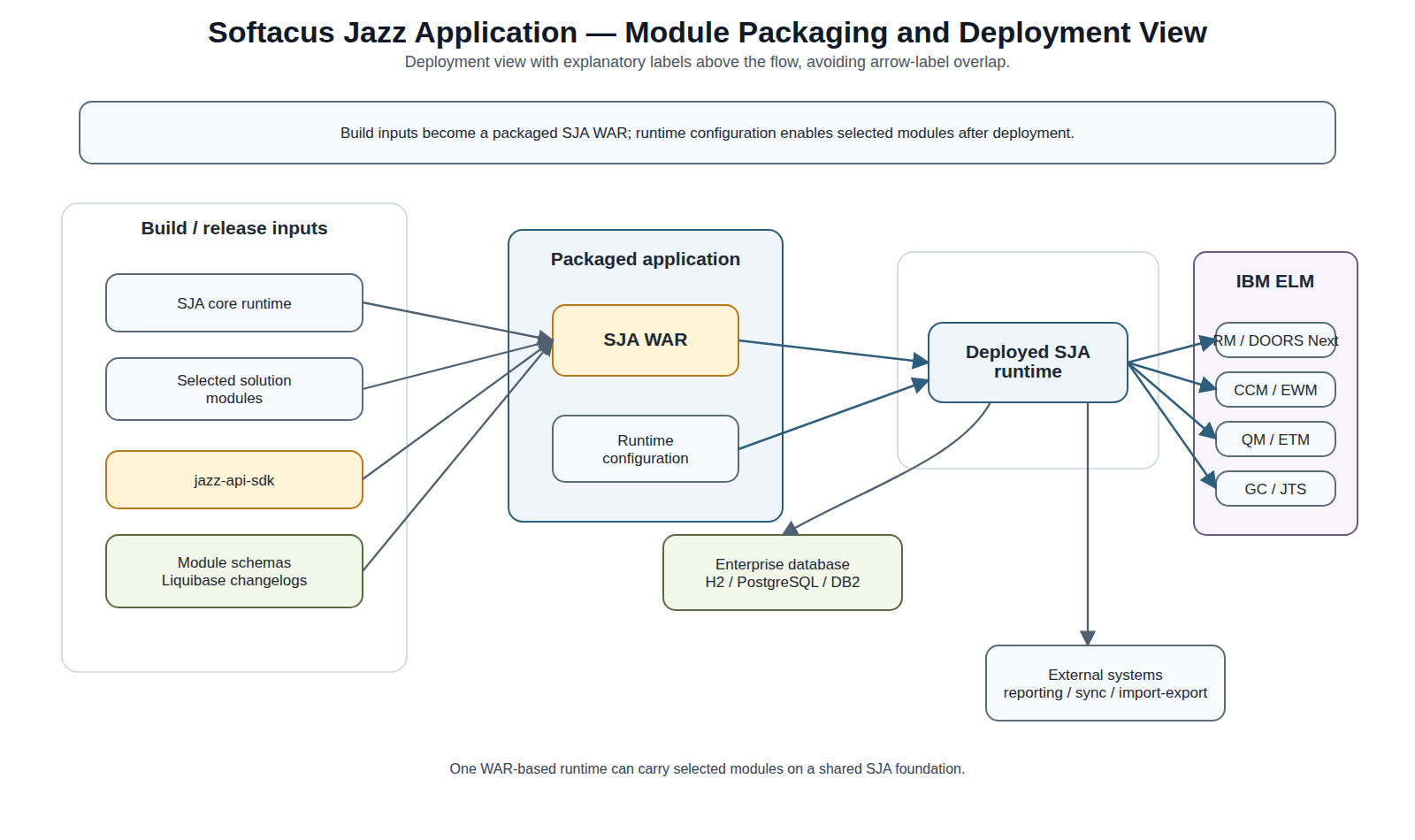
From a packaging perspective, the platform combines the SJA runtime, selected solution modules, SDK layer, runtime configuration and module schemas into a deployable application. This makes it possible to deliver multiple business capabilities through one maintained runtime instead of separate integration stacks.

Selected modules, runtime configuration, SDK and schemas are packaged into a WAR-based SJA runtime that connects to IBM ELM and enterprise services.
The platform can support enterprise persistence needs through database backends such as H2, PostgreSQL and DB2, with Liquibase changelogs for module schemas. This is important for modules that store configuration, workflow state, metrics, locks, access requests or synchronization data.
The deployment message is not that every environment looks the same. The message is that SJA provides a repeatable platform model for delivering solution-specific modules into real IBM ELM landscapes.
Business value
Softacus Jazz Application helps teams move from one-off Jazz extensions to a maintained extension platform.
For engineering managers, this means custom workflows can be delivered on a more consistent foundation. For IBM ELM administrators, it means fewer independent integration patterns to understand and maintain. For solution architects, it provides a clearer place to reason about authentication, configuration context, application routing, persistence and cross-system communication.
The main benefits are practical:
● Less duplicated IBM ELM integration logic across modules
● One reusable foundation for widgets, automation and external integrations
● More consistent delivery of modular business solutions
● Better maintainability through a centrally maintained SDK and proxy layer
● Improved upgrade readiness by keeping IBM ELM API complexity in fewer places
● Support for enterprise persistence and module-specific data needs
Closing
IBM ELM is a strong platform for lifecycle engineering, but real customer environments often need additional workflows, integrations and automations. Building those capabilities one by one can create unnecessary technical debt.
Softacus Jazz Application provides a maintained middleware layer for extending IBM ELM in a more structured way. By centralizing communication through reusable SDK and proxy layers, SJA helps teams deliver advanced widgets, automation services and solution modules without rebuilding the same integration foundation every time.
For organizations extending IBM ELM, SJA is not just another custom extension. It is a platform for making extensions more maintainable, modular and ready for long-term evolution.
Sign up to our newsletter
Our Services
Our Extensions
Latest blog articles
Contact Us!
Softacus Services
We, in Softacus, are experts when it comes to consulting and service delivery of IBM software products and solutions in your business. We help our clients to improve visibility and transparency when licensing and managing commercial software, providing measurable value while increasing efficiency and accountability and we are providing services in different areas (see Softacus Services).
IBM ELM extensions developed by Softacus are free of charge for the customers who ordered IBM ELM licenses via Softacus or for the customers who ordered any of our services. If you are interested in any of our IBM ELM extensions, you found a bug or you have any enhancement request, please let us know at info@softacus.com.