Aircraft safety assessment is not a one-time calculation or a document produced at the end of development. It is an iterative engineering process that connects aircraft functions, failure conditions, safety objectives, architecture decisions, derived requirements, verification results, assumptions, and changes.
SAE ARP4761A provides guidelines and methods for conducting safety assessments of civil aircraft, systems, and equipment. Published in December 2023, it is the current revision of ARP4761 and has the EUROCAE counterpart ED-135. Programs should identify the revision and regulatory basis agreed for their project rather than silently treating ARP4761 and ARP4761A as interchangeable.
IBM Engineering Lifecycle Management can help teams keep the resulting information connected. DOORS Next, Rhapsody Model Manager, Engineering Test Management, Engineering Workflow Management, configuration management, OSLC links, dashboards, and reporting can form part of a digital thread. That thread must be deliberately designed and governed; it does not emerge automatically from installing the tools.
What Is ARP4761A?
ARP4761A is an SAE Aerospace Recommended Practice for the safety-assessment process. It describes a systematic approach and a set of analysis methods that organizations may use when addressing applicable certification requirements or internal safety objectives. It is guidance, not a standalone regulation and not the only possible acceptable process.
For transport-category airplanes, FAA AC 25.1309-1B explains that ARP4761 contains recognized safety-assessment methods when correctly applied, while applicants remain responsible for selecting an acceptable means of compliance and coordinating it with the authority. That distinction matters for marketing language: software can support the work and evidence, but neither ARP4761A nor IBM ELM independently certifies an aircraft or organization.
How ARP4761A Relates to ARP4754B
ARP4754B addresses aircraft and system development. ARP4761A addresses the associated safety-assessment process. The two lifecycles interact: safety assessments identify and refine safety needs; architecture and requirements provide design information to assess; verification and implementation evidence help confirm that the final design satisfies the applicable safety requirements.
A Functional Hazard Assessment identifies and classifies failure conditions according to their effects. Those classifications inform quantitative and qualitative safety objectives and the development assurance process. Avoid saying that FHA simply assigns a minimum DAL. Development assurance levels and allocations require the coordinated process, assumptions, architecture, and applicable guidance defined for the program.
The Safety-Assessment Flow: FHA, PSSA, and SSA
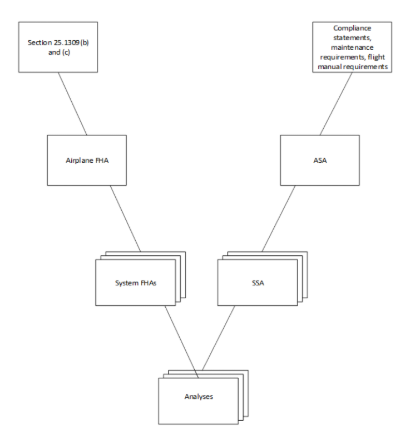
The Aircraft Functional Hazard Assessment and System Functional Hazard Assessments establish a functional view of possible failure conditions and their severity. This early work creates safety objectives and inputs that must remain connected to the functions, operational context, assumptions, and affected systems.
The Preliminary Aircraft or System Safety Assessment evaluates the proposed architecture against those objectives. Techniques such as Fault Tree Analysis and supporting qualitative or quantitative analyses help determine whether independence, redundancy, monitoring, fault containment, and allocated safety requirements are adequate for the preliminary design.
The Aircraft or System Safety Assessment evaluates the implemented design and the body of supporting evidence. It confirms, at the appropriate level, that applicable safety requirements and objectives are met. The exact set and depth of analyses depend on the functions, failure-condition severity, design complexity, novelty, assumptions, and agreed certification approach.

1.) Compliance Process Diagram
Core Analysis Methods and the Evidence They Create
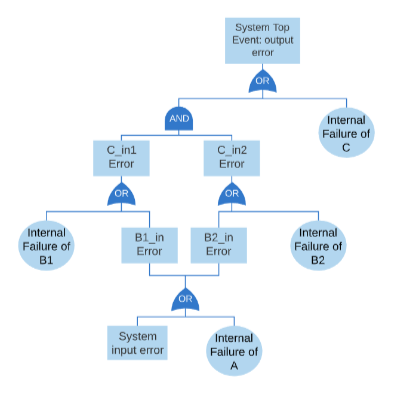
Fault Tree Analysis is deductive: it starts with an undesired top event and models combinations of lower-level events that can cause it. Failure Modes and Effects Analysis is inductive: it starts with component or item failure modes and evaluates their effects. These techniques answer different questions and often provide complementary evidence.
Common-cause work examines threats to independence and assumptions. Zonal Safety Analysis addresses installation and co-location concerns. Particular Risks Analysis examines defined external or environmental risks. Common Mode Analysis considers common mechanisms that could defeat intended independence. Current guidance also recognizes analyses such as Cascading Effects Analysis. A project should use the methods and terminology required by its agreed process, not a generic one-size-fits-all checklist.
Every analysis carries context: configuration, assumptions, data sources, calculation versions, analyst decisions, review status, and links to affected functions or requirements. Managing those relationships is where lifecycle tooling can add more value than a collection of disconnected spreadsheets and static documents.

2.) Fault Tree Analysis (FTA) Diagram
A Practical IBM ELM Information Model
DOORS Next can manage structured requirements and project-defined artifact types for failure conditions, safety objectives, safety requirements, assumptions, analysis references, and review records. This is an implementation choice, not a mandatory ARP4761A data model. Teams should define attributes, link semantics, states, permissions, and configuration behavior before loading safety data.
Rhapsody and Rhapsody Model Manager can manage system architecture and expose model elements for lifecycle traceability. IBM documentation supports OSLC relationships between DOORS Next artifacts and architecture elements, including refinement, trace, satisfaction, and derivation relationships. The link shows an engineering relationship; it does not prove that the model is correct or that a safety objective is satisfied.
Engineering Test Management can manage test plans, cases, execution records, results, and requirement-validation links.
Engineering Workflow Management can manage work items, ownership, approvals, change activity, and corrective actions.
Neither application should be described as the automatic home of every safety analysis. The allocation of artifacts should follow the organization’s process, reporting, access, configuration, and audit needs. Neither application should be described as the automatic home of every safety analysis. The allocation of artifacts should follow the organization’s process, reporting, access, configuration, and audit needs.
Build Traceability Around Safety Questions
A useful digital thread should answer concrete questions: Which failure condition led to this safety objective? Which requirement implements the objective? Which architecture element satisfies or refines the requirement? Which analysis supports the allocation? Which test or review provides verification evidence? Which change affected the conclusion, and who assessed the impact?
OSLC links can connect lifecycle artifacts across IBM applications without copying all data into one repository. However, links are directional, owned by an application, and resolved within configuration context. Teams must define link types and ownership consistently, manage access and project associations, and verify that reports resolve the intended versions.
The original article’s claim that Rhapsody changes automatically propagate to safety requirements is too broad. A model change does not automatically rewrite or approve a linked requirement. IBM ELM can expose relationships, support change workflows, and help users analyze affected artifacts; automatic updates or impact identification require explicit process logic, integrations, extensions, or automation and should be validated before being promised.
Control Configuration, Reviews, and Change
Safety conclusions are only meaningful in a known configuration. Baselines and global configurations can identify compatible versions of requirements, architecture, tests, and other lifecycle data for a milestone or review. Teams should decide which artifacts are versioned, which links are included or discovered, who may change them, and how a released evidence set is reconstructed later.
Reviews should record scope, participants, criteria, decisions, findings, and dispositions. A review status alone is not enough if the associated artifact versions or assumptions have changed. When a safety-relevant requirement, model element, analysis, or verification result changes, the workflow should trigger proportionate impact analysis and reapproval based on the project’s defined rules.
EWM work items can provide ownership and closure for change and findings, while DOORS Next retains requirement and safety relationships and ETM retains verification records. Dashboards and reports can expose missing links, unresolved findings, suspect relationships, and incomplete validation. Their usefulness depends on a well-designed information model and disciplined data quality.
Recommended ARP4761A Digital-Thread Workflow
Begin with process architecture. Define the applicable regulations, guidance revision, certification approach, safety plans, artifact ownership, review gates, configuration strategy, and evidence outputs. Then create a safety information model that names the artifact types, mandatory attributes, relationships, states, and responsibilities needed to answer audit and engineering questions.
Capture functions, failure conditions, classifications, objectives, assumptions, and safety requirements in controlled repositories. Link them to the relevant architecture and analysis records. Treat external FTA, FMEA, reliability, or model-based safety tools as governed sources when they remain outside IBM ELM; integrate identifiers, versions, results, and status rather than implying that ELM natively performs every specialized analysis.
Connect verification cases and results to the safety requirements they address. Track review findings and changes to closure. Use baselines and global configurations at defined milestones, and generate evidence views that show coverage, unresolved gaps, suspect links, assumptions, verification status, and configuration identity. Validate those reports against the actual certification plan before relying on them.
Common Mistakes to Avoid
Common mistakes include calling ARP4761A a regulation, using ARP4761 and ARP4761A without stating the project baseline, treating failure-condition classification as an automatic DAL assignment, forcing every safety artifact into one application, and confusing the existence of a link with proof of satisfaction.
Other risks include ungoverned spreadsheet calculations, missing analysis assumptions, links that resolve to the wrong configuration, dashboards that hide data-quality gaps, safety findings without owners, and automation that updates evidence without review. The goal is not the highest number of links. It is a controlled, intelligible evidence chain that engineers and reviewers can reconstruct.
Where Softacus can help
Softacus can help aerospace teams translate a safety-assessment process into a practical IBM ELM architecture. That can include DOORS Next artifact and module structures, attributes and link types, Rhapsody Model Manager integration, ETM verification relationships and EWM finding and change workflows, configuration management, dashboards, reports, templates, migration, training, and governance guidance.
Conclusion
ARP4761A safety assessment depends on disciplined engineering judgment and a connected body of evidence. The value of IBM ELM is not that it replaces FHA, PSSA, SSA, FTA, FMEA, or specialist safety tools. Its value is that it can connect their outputs to requirements, architecture, verification, change, reviews, and configurations in a lifecycle that remains visible and governable.
A successful implementation starts with the safety and certification questions, then configures the tools to preserve the answers. With the right information model and governance, IBM ELM can help aerospace teams identify gaps earlier and prepare evidence that is easier to review, change, and defend.
Frequently asked questions
Sign up to our newsletter
Our Services
Our Extensions
Latest blog articles
Contact Us!
Softacus Services
We, in Softacus, are experts when it comes to consulting and service delivery of IBM software products and solutions in your business. We help our clients to improve visibility and transparency when licensing and managing commercial software, providing measurable value while increasing efficiency and accountability and we are providing services in different areas (see Softacus Services).
IBM ELM extensions developed by Softacus are free of charge for the customers who ordered IBM ELM licenses via Softacus or for the customers who ordered any of our services. If you are interested in any of our IBM ELM extensions, you found a bug or you have any enhancement request, please let us know at info@softacus.com.