Requirements reviews are a core verification activity in safety-critical and highly regulated engineering. They help teams find ambiguity, inconsistency, incompleteness, infeasibility, and traceability gaps before those defects spread into architecture, implementation, testing, and safety evidence.
A review becomes weak evidence when the artifacts change during the review, when decisions cannot be tied to the exact version reviewed, when the evaluation criteria are unclear, or when linked context has moved on. The challenge is not simply collecting comments. It is preserving what was reviewed, how it was evaluated, who decided what, which findings remained, and which configuration made the conclusions meaningful.
IBM Engineering Requirements Management DOORS Next, often still called DNG, provides reviews, comments, participant roles, verdicts, modules, baselines, configuration management, and traceability. Those capabilities are building blocks. The organization must still define the review method, responsibilities, acceptance criteria, escalation rules, and evidence required by its standards and assurance case.
What Makes a Formal Requirements Review Audit-Ready?
A formal requirements review is a planned and recorded evaluation of a defined set of artifacts against stated criteria. The evidence should make the review reconstructable: an independent reader should be able to identify the scope, artifact versions, context, participants, roles, criteria, decisions, comments, findings, follow-up actions, and final status.
No single comment pattern or tool status creates that result. Audit readiness comes from combining stable lifecycle data with a process that is explicit about who approves, what counts as complete, how disagreements are resolved, how findings are tracked, and when changed requirements must be reviewed again.
Principle 1: Use Standardized Evaluation Criteria
Review quality should not depend entirely on the preferences or memory of an individual reviewer. A controlled checklist or review guide can establish common criteria for correctness, clarity, completeness, consistency, verifiability, feasibility, safety relevance, traceability, and project-specific conventions.
Preserve the checklist version or an immutable reference to it with the review evidence. Adding the checklist as a review artifact can be a practical pattern, but it is not the only implementation. The essential outcome is that future reviewers and auditors can determine which criteria were in force when the decisions were made.
Principle 2: Keep the Review Scope Stable
IBM documentation allows a review to be created in a stream or in a baseline. A stream remains editable, while a baseline is frozen. For compliance-oriented reviews where comments and verdicts must remain tied to an exact artifact state, a baseline is usually the stronger choice and is also the pattern shown in IBM’s getting-started workflow.
A stream-based review may still be appropriate for an iterative working review in which authors revise artifacts and reviewers reassess them before final approval. The process must make that intent clear. Do not accidentally use a mutable stream when the evidence package assumes an immutable scope.
Principle 3: Preserve the Review Evidence
After approval, requirements will continue to evolve. Historical evidence must still show the reviewed version, participants, roles, decisions, review-specific comments, due dates or instructions where relevant, and the final review status. If the visible artifact changes while the record still appears to approve it, the evidential value is weakened.
DOORS Next baselines preserve a read-only snapshot of versioned artifacts. Projects can also configure electronic signatures on baselines when organizational policy requires them. Electronic signatures are an optional governance capability, not a universal requirement for every review.
Principle 4: Preserve the Traceability Context
Requirements are often reviewed against stakeholder needs, safety goals, hazards, architecture, assumptions, tests, and downstream allocations. The review conclusion depends on those relationships. Preserving only the text of the reviewed requirement may be insufficient if the linked artifacts and links later resolve to different versions.
Configuration management and global configurations can provide the version context in which links resolve. For a cross-domain review, a global baseline or another controlled configuration pattern may be appropriate. A baseline staging stream can help a configuration lead assemble and commit a milestone, but it is an advanced pattern rather than a mandatory prerequisite for every DOORS Next review.
Principle 5: Manage Findings to Closure
A review is not complete simply because participants clicked Reviewed or Approved. Disapproved artifacts, unresolved comments, deviations, and action items need a defined disposition. Projects may represent findings as DOORS Next artifacts, EWM work items, problem reports, or records in another controlled system.
The process should define who owns each finding, how it links to the affected requirement, which change implements the correction, what evidence confirms closure, and whether rework triggers another review. The tool model can vary; closure and traceability cannot be implicit.
How DOORS Next Reviews Work
DOORS Next can create a review for selected artifacts, a collection, or a module. Participants can be assigned as approvers, reviewers, or optional reviewers. Depending on role, they can approve, disapprove, mark an artifact reviewed, approve or review with comments, or abstain. The review follows lifecycle states from draft through in progress and reviewed to finalized.
Reviews are associated with the configuration in which they are created, and review comments are shown in the context of that review. This makes configuration selection a process decision, not a cosmetic setting. Review owners should record the purpose, scope, due date, instructions, roles, and completion rules before inviting participants.
Module Review vs. Individual Artifact Review
A module review preserves document order, hierarchy, surrounding requirements, and module-context links or comments. It is often the stronger choice when reviewers must judge consistency, completeness, flow, and traceability in context. Modules can also be filtered so only a defined subset is in scope.
An individual artifact review provides clearer per-artifact granularity and simpler reporting of decisions. It can be useful when the scope is assembled across folders or modules. However, reviewers may need to open the relevant module or other context separately, especially because links, tags, and comments can be specific to a module context or to the base artifact.
There is no universal winner. Choose the scope object based on the review question. Use module-level review when context is central; use artifact-level review when precise item status and cross-document selection are more important. Document any reporting or context workarounds instead of presenting one option as automatically compliant.
Recommended DOORS Next Review Workflow
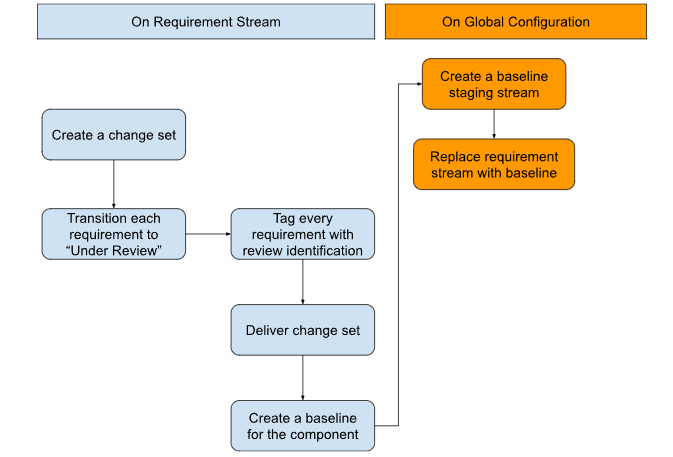
Prepare the review by defining the purpose, scope, roles, checklist, entry criteria, completion rules, finding workflow, and configuration strategy. If the review is intended to produce frozen approval evidence, create a baseline after confirming that the scope and link context are ready. For a cross-application review, assemble the relevant requirements, architecture, test, and other configurations in a controlled global configuration.
Create the review in the intended configuration and add the module, collection, or selected artifacts. Add the checklist or a controlled reference when the process requires it. Add participants with the correct roles and provide instructions that explain what decisions and comments are expected. Tags or attributes can help identify partial module scope, but they should be governed and should not replace the review’s explicit artifact list.
During execution, reviewers evaluate each item against the criteria and use the available verdicts consistently. Comments should be required for defects, disapproval, abstention, or rationale that must be retained. Requiring an “OK” comment on every accepted item can provide explicit evidence, but it also creates volume; use that convention only when the process and reporting need justify it.
Finalize the review only after required participants complete their decisions and findings have an agreed disposition. Apply corrections in a writable stream or change set, not in the frozen baseline. Link rework to findings and affected requirements, perform impact analysis, and start a new review when the changed content or policy requires reapproval. Preserve the finalized review and the relevant baseline or global configuration as part of the evidence package.

1.) Task Flow for Prepare for Review Activity
How This Supports Automotive SPICE and ISO 26262 Work
Automotive SPICE and ISO 26262 use different structures and terminology, and their exact requirements must be interpreted from the licensed standards, assessment model, organizational process, and project scope. DOORS Next does not certify a process or guarantee compliance. It can support common evidence needs such as defined review criteria, controlled work products, recorded decisions, tracked findings, traceability, configuration identification, and change management.
The strongest claim is that a disciplined DOORS Next review workflow can help implement and demonstrate parts of an Automotive SPICE or ISO 26262-aligned process. Assessment readiness depends on how the organization configures the tools, executes the process, retains objective evidence, and resolves deviations.
Common Mistakes to Avoid
Common failures include creating an approval review in a mutable stream by accident, reviewing base artifacts while assuming module-context links are visible, using status or tags as a substitute for explicit scope, finalizing with unresolved findings, losing the checklist version, editing content after review without impact analysis, relying on comments without per-artifact decisions, and assuming that a global configuration automatically preserves every relevant relationship.
Another mistake is overengineering the workflow. A baseline staging stream, custom finding artifact, positive comment on every item, or dual-window consolidation method can be useful, but each adds process cost. Adopt it because the evidence model requires it, not because the tool makes it possible.
Where Softacus Can Help
Softacus can help teams translate review-policy expectations into a practical IBM ELM configuration. That can include review roles and instructions, requirement states, artifact and link types, checklist templates, module conventions, baseline and global configuration patterns, finding workflows, electronic-signature settings, dashboards, reports, and evidence-package outputs.
We can also help analyze the boundary between DOORS Next and EWM. Findings that require ownership, planning, source changes, or cross-team resolution may be better represented as EWM work items, while requirement-specific review comments and decisions remain in DOORS Next. The correct design depends on reporting, permissions, audit, and configuration needs.
Conclusion
DOORS Next provides the building blocks for controlled requirements reviews, but formal evidence depends on disciplined process design. Stable scope, explicit criteria, preserved decisions, managed findings, correct configuration context, and controlled change are what keep a review meaningful over time.
For regulated engineering teams, the practical goal is not to make every review maximally complex. It is to choose a review pattern that matches the assurance need and preserves enough context for future reviewers to understand exactly what was evaluated and approved. IBM ELM can support that lifecycle, and Softacus can help teams configure it in a way that is practical, reportable, and audit-ready.
Frequently asked questions
Sign up to our newsletter
Our Services
Our Extensions
Latest blog articles
Contact Us!
Softacus Services
We, in Softacus, are experts when it comes to consulting and service delivery of IBM software products and solutions in your business. We help our clients to improve visibility and transparency when licensing and managing commercial software, providing measurable value while increasing efficiency and accountability and we are providing services in different areas (see Softacus Services).
IBM ELM extensions developed by Softacus are free of charge for the customers who ordered IBM ELM licenses via Softacus or for the customers who ordered any of our services. If you are interested in any of our IBM ELM extensions, you found a bug or you have any enhancement request, please let us know at info@softacus.com.