Airborne software verification traditionally relies on reviews, analyses, requirements-based tests, and structural coverage activities. Formal methods add another way to establish selected properties of requirements, designs, or source code: mathematical reasoning supported by precisely defined notation, assumptions, and analysis techniques.
This creates a certification question: when a project uses a proof, model checker, or abstract interpreter to satisfy part of a DO-178C verification objective, how does it show that the formalization, method, tool, assumptions, results, and lifecycle evidence are trustworthy?
DO-333 addresses that question. It is the Formal Methods Supplement to DO-178C and DO-278A. DO-333 doesn't replace the base standards, and formal methods don't automatically replace all dynamic testing. The supplement modifies selected objectives and provides additional guidance when formal analysis is used to obtain certification credit.
What Is DO-333?
DO-333 provides a framework for applying formal methods within the airborne or ground-based software lifecycle. In Europe, the related EUROCAE designation is ED-216. A formal method uses mathematically based notation and reasoning to specify, develop, or verify software properties. Formal analysis is the use of such a method to satisfy, in whole or in part, an applicable verification objective.
Common techniques discussed in formal-methods programs include abstract interpretation, model checking, deductive verification, theorem proving, satisfiability-based analysis, and formal specification. The specific technique matters less than the assurance argument: the project must define what property is being established, why the method is appropriate, what assumptions and limitations apply, and what evidence supports the claimed credit.
Why DO-333 Is Needed
Testing observes software behavior for selected inputs and execution conditions. Formal analysis can reason about broader classes of behavior, but only within a defined mathematical model and its assumptions. It can help establish properties such as absence of selected run-time errors, satisfaction of contracts, invariant preservation, unreachable states, or conformance between an implementation and a formalized requirement.
Certification becomes more complex when proof replaces or reduces another verification activity. Reviewers need confidence that the informal requirement was formalized correctly, that the analysis is sound for the claimed property, that assumptions are valid, that limitations are documented, and that changes trigger appropriate reanalysis. A successful proof of the wrong property is not useful evidence.
DO-333 was created to bring structure to this use of formal methods. It enables objective-specific credit while preserving the planning, traceability, independence, configuration control, quality assurance, and certification liaison expected in the DO-178C ecosystem.
The Formal-Analysis Assurance Shift
In a DO-333 lifecycle, the verification record extends beyond a pass/fail test result. It may include the source requirement, its formal representation, proof obligations or properties, the analyzed model or code, analysis configuration, assumptions, tool version, results, unresolved conditions, review records, and the baseline in which those items belong.
A practical workflow begins by identifying the DO-178C objective for which formal analysis will be used. The team defines the formal property, validates its relationship to the source requirement, selects and justifies the method, performs the analysis, reviews the results and limitations, resolves counterexamples or unproved obligations, establishes any required tool confidence, and preserves the evidence under configuration control.
Formal Methods Used in DO-333 Programs
Abstract interpretation computes a conservative approximation of program behavior. Depending on the analyzer, abstract domain, and configuration, it may help establish the absence of selected run-time errors or provide bounds on values and control states. The analysis claim must be limited to the properties and assumptions actually supported.
Model checking explores a formal state model against stated properties. It can confirm a property within the modeled state space or produce counterexamples that reveal violated assumptions, deadlocks, unreachable states, or unsafe sequences. The assurance argument must account for the relationship between the checked model and the implementation.
Deductive verification and theorem proving use logic, contracts, invariants, and proof obligations to show that an implementation or model satisfies specified properties. Proof may be automated, interactive, or mixed. Human review remains important where specifications, lemmas, abstractions, or proof strategies influence the result.
Can Formal Methods Replace Dynamic Testing?
Formal analysis can receive credit toward specific DO-178C verification objectives when the DO-333 guidance is satisfied and the approach is accepted for the project. It should not be described as a blanket substitute for dynamic testing. The credit depends on the property proved, the lifecycle data analyzed, the adequacy and soundness of the method, the assumptions made, the applicable software level, and the remaining objectives.
Projects may still need executable-object-code verification, hardware/software integration evidence, robustness testing, timing or resource measurements, target-environment behavior, and other activities that are not established by a particular proof. The safest content position is that formal methods can complement testing and, in approved cases, reduce or replace selected verification activities.
How DO-333 Connects to DO-178C
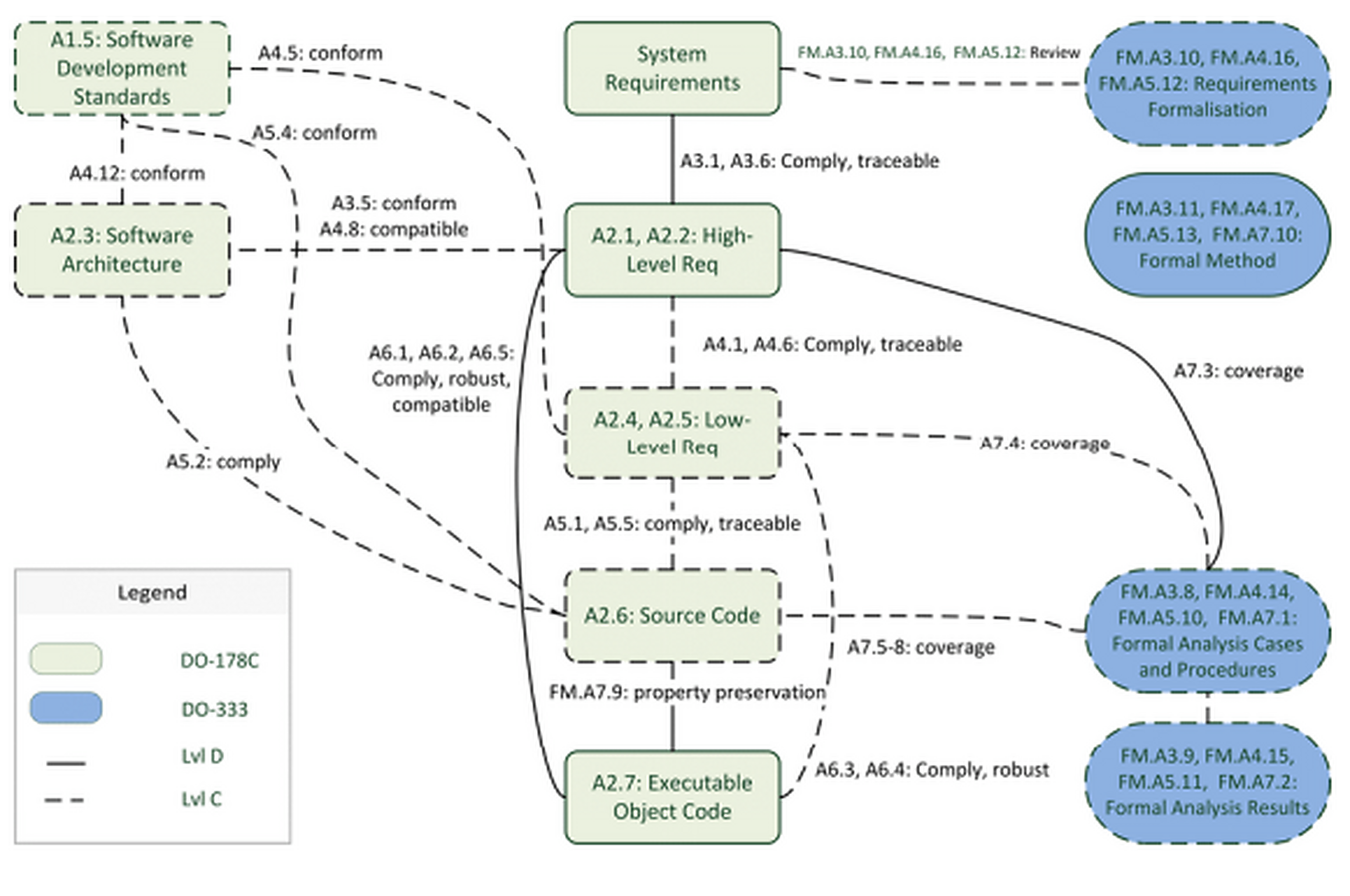
DO-178C remains the core airborne software assurance framework. DO-333 adds, modifies, or deletes content associated with selected verification objectives when formal methods are used. Requirements traceability, verification of high- and low-level requirements, software architecture and source-code verification, structural coverage considerations, configuration management, software quality assurance, change control, independence, and Development Assurance Level considerations remain part of the certification picture.
The key difference is the form of some objective evidence. Instead of relying only on reviews or test execution, the project may use formal analysis to demonstrate a property. That evidence must remain understandable, reproducible, configuration-controlled, traceable to the relevant lifecycle data, and bounded by explicit assumptions and limitations.

1.) DO-178C And DO-333 Interactions
Traceability in a DO-333 Lifecycle
Traceability is one of the hardest parts of formal-methods adoption. A project may need links from natural-language requirements to formal requirements or properties, from properties to models or code, from proof obligations to analysis runs and results, and from unresolved findings to problem reports, changes, reviews, and baselines.
If these relationships are maintained across separate spreadsheets, proof logs, source repositories, model files, and test systems, the assurance argument becomes fragile. A change to a requirement can invalidate its formalization, proof obligations, assumptions, analysis configuration, and downstream results. Teams need a connected view of what changed, which claims are affected, which analyses must be repeated, and which evidence remains valid.
How IBM ELM Can Support DO-333 Work
IBM Engineering Lifecycle Management can help teams manage the evidence chain around formal analysis. IBM DOORS Next can capture natural-language requirements, formal properties or references to them, reviews, baselines, and traceability links. IBM Rhapsody and Rhapsody Model Manager can support architecture and behavioral models, collaborative reviews, configuration management, and lifecycle links when models participate in the formal-methods workflow.
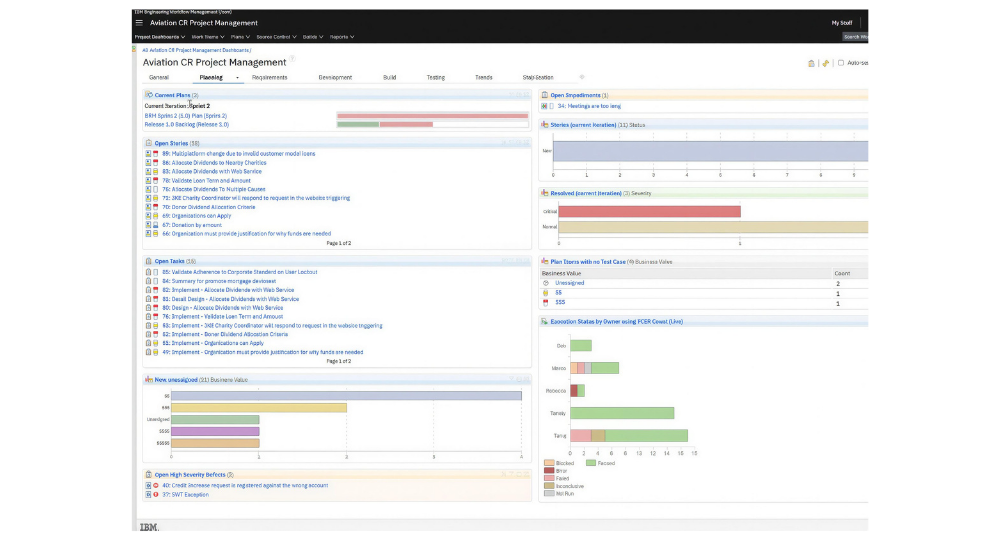
IBM Engineering Test Management can organize verification plans, cases, execution records, analysis procedures, evidence references, results, and unresolved outcomes. IBM Engineering Workflow Management can support work items, source changes, problem reports, approvals, and configuration workflows. IBM Engineering Lifecycle Optimization - Method Composer can help process owners document and publish roles, tasks, work products, review criteria, and guidance for a repeatable formal-analysis process.
Specialist tools such as SPARK, Frama-C, Polyspace, model checkers, theorem provers, or abstract interpreters perform the formal analysis. IBM ELM does not replace those engines. Its value is to connect their inputs, outputs, assumptions, reviews, and change records to the wider engineering lifecycle through native links, OSLC where supported, integrations, APIs, or controlled evidence references.
Softacus can frame its role around configuring this environment so the evidence is easier to create, connect, review, and maintain. The article should not claim that IBM ELM makes a project compliant or that it validates proof soundness. A stronger and safer claim is that a well-configured IBM ELM environment can support the traceability, governance, configuration context, and evidence management needed for a DO-333 certification argument.
Formal-Analysis Tool Qualification Under DO-330
A formal-analysis tool is not automatically subject to qualification merely because it is used on a DO-333 project. The qualification decision depends on the tool function, intended use, certification credit claimed, and whether an error in the tool output could introduce or fail to detect an error that is not otherwise detected by the planned lifecycle activities.
The tool qualification level is determined using the DO-330 criteria for the specific use case; it should not be inferred from the software level alone or stated as a universal TQL-1 or TQL-4 rule. In some strategies, independent verification, checking of proof artifacts, dissimilar tools, or other lifecycle activities may affect the qualification argument. Program-specific plans and authority coordination remain essential.

2.) Related IBM EWM Interface
Where Softacus can help
For teams applying formal methods under DO-333 expectations, the challenge is not only running a proof tool. The harder challenge is proving how the formal property relates to the source requirement, which model or code was analyzed, what assumptions and options were used, what result was obtained, which limitations remain, and whether the evidence is still valid after change. Softacus can help teams configure IBM ELM so those relationships are easier to manage and explain during review.
Softacus can support the practical setup of DO-333-oriented workflows across the IBM ELM toolchain. In DOORS Next, this can mean structuring requirements, formal-property artifacts, attributes, reviews, and traceability. In Rhapsody and Rhapsody Model Manager, it can mean organizing architecture or behavior models, configuration awareness, and links to the requirements and analyses they support. Specialist formal-analysis tools remain responsible for producing the proof or analysis result.
Softacus can also help define EWM processes for proof-impact assessment, source or model changes, approvals, issue handling, configuration control, and problem reporting. In ETM, this can mean creating a controlled structure for analysis procedures, tool configurations, evidence references, results, counterexamples, unproved obligations, limitations, and review status. Integration scope should be based on each specialist tool’s available APIs and the project’s evidence model.
Need help setting up IBM ELM for DO-331 tool qualification?
Softacus can help you structure requirements, tests, workflows, baselines, approvals, and reporting views so your qualification evidence stays traceable and easier to review.
Conclusion
DO-333 connects mathematically based software verification with the assurance discipline expected under DO-178C. It allows formal analysis to support selected certification objectives when the property, method, assumptions, soundness, lifecycle data, results, and configuration evidence are adequately justified.
For aerospace and defense teams, the real challenge is not simply selecting a theorem prover, model checker, or static analyzer. It is maintaining a clear line from requirements to formal properties, analyzed artifacts, proof obligations, results, limitations, changes, and approved baselines. IBM ELM can support that connected lifecycle, and Softacus can help teams configure it in a way that is practical, auditable, and easier to maintain.
Frequently asked questions
Continue the series
Sign up to our newsletter
Our Services
Our Extensions
More DO Content
Latest blog articles
Contact Us!
Softacus Services
We, in Softacus, are experts when it comes to consulting and service delivery of IBM software products and solutions in your business. We help our clients to improve visibility and transparency when licensing and managing commercial software, providing measurable value while increasing efficiency and accountability and we are providing services in different areas (see Softacus Services).
IBM ELM extensions developed by Softacus are free of charge for the customers who ordered IBM ELM licenses via Softacus or for the customers who ordered any of our services. If you are interested in any of our IBM ELM extensions, you found a bug or you have any enhancement request, please let us know at info@softacus.com.