How DO-178C Software Development Processes Are Supported by the IBM ELM Lifecycle Suite
Part 3 of the DO-178C and IBM ELM series
With planning in place, the next challenge is execution. In a DO-178C project, software development is not only about turning requirements into design and code. Teams also need to show that those activities were controlled, reviewed, and kept traceable as the system evolved.
That is usually where the workload starts to grow. Requirements change, designs are refined, code is updated, and evidence has to keep up with each step. If those relationships are managed across separate tools or manual records, gaps appear quickly.
IBM Engineering Lifecycle Management (ELM) helps teams manage this in one connected environment. This article looks at how IBM ELM supports key DO-178C software development activities and what that means in day-to-day project work.
What DO-178C Expects from Software Development
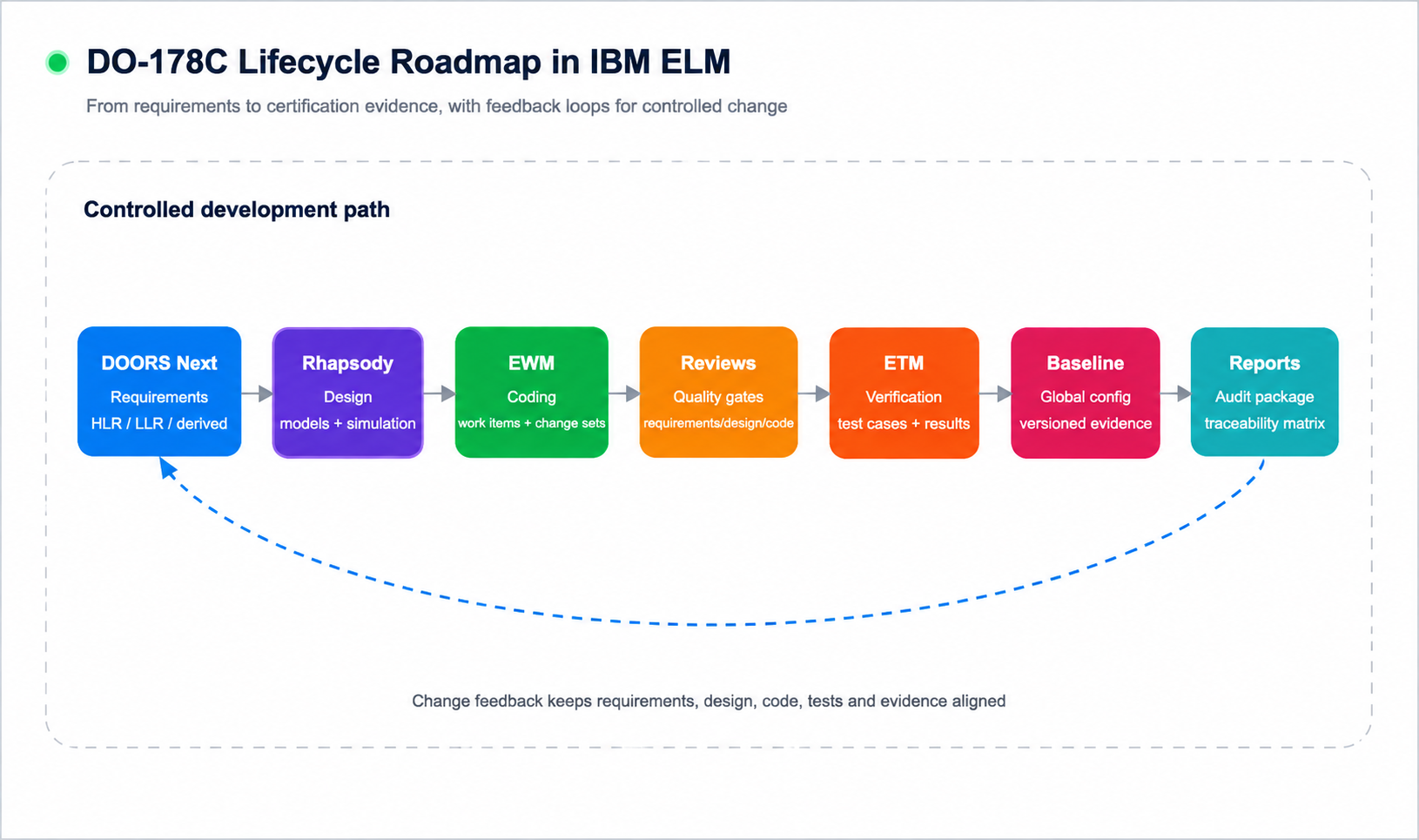
In practice, DO-178C expects teams to manage software development across three closely connected areas: requirements development, software design, and coding with integration. Each area must be controlled, reviewed, and traceable so that teams can show how high-level system needs are transformed into verified software behavior.
Each step has strict objectives, such as:
● Consistent and traceable refinement of requirements
● Documented design that supports verifiable implementation
● Coding standards and conformance
● Traceability from requirements through design, source code, and tests
● Reviews that show correctness, consistency, and compliance
● Controlled changes and baselines
This is often the point where teams lose time. The issue is not understanding what DO-178C asks for. The issue is keeping requirements, design, implementation, and reviews aligned once the project is moving and changes start to accumulate.
IBM ELM consolidates all components into one structured system, allowing teams to stay compliant while still working efficiently.
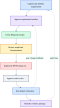
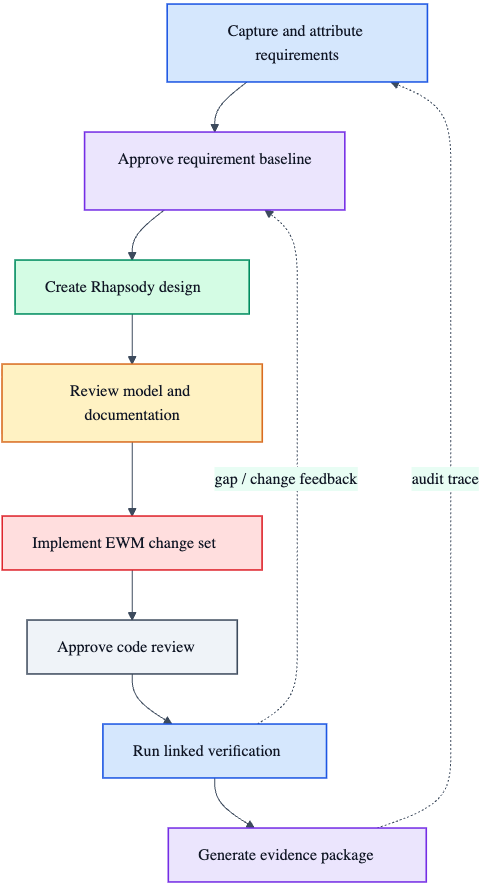
1. Software requirements set the direction for everything that follows. If they are unclear, weakly linked, or poorly controlled, the problems spread into design, code, and verification.
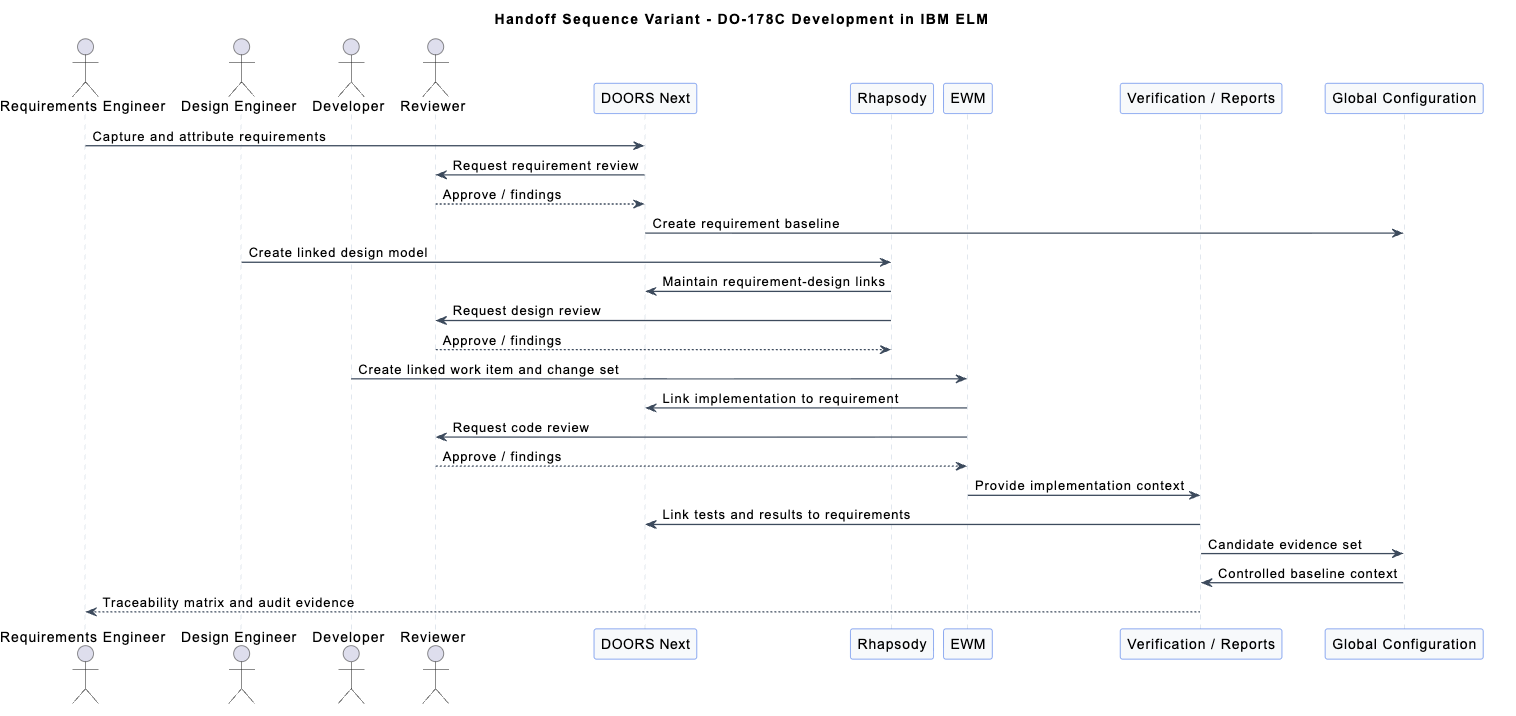
In IBM ELM, DOORS Next helps teams manage high-level, derived, and low-level software requirements in a controlled structure. Requirements can be organized in version-controlled modules, enriched with important attributes such as DAL level, safety tags, verification method, and priority, and reviewed before they are approved for use.
Just as importantly, requirements can be linked to design artifacts, model elements, change requests, and verification results. This gives teams the traceability they need to show how each requirement was implemented, verified, and controlled throughout the lifecycle.
For certification audits, this traceability is not just useful. It becomes the evidence that connects engineering decisions to compliance expectations.
2. System and Software Design with Engineering Systems Design Rhapsody
DO-178C expects software design to be clear, consistent, and verifiable. IBM Engineering Systems Design Rhapsody supports this through model-based design, which can be used in a DO-178C context together with the DO-331 supplement.
With Rhapsody, teams can create architecture views, block diagrams, activity charts, and state charts in a controlled engineering environment. These models can be linked directly to requirements, simulated to identify issues earlier, and checked for design consistency before problems move further into development.
Rhapsody also helps generate design documentation that can support certification evidence. Instead of relying on informal “whiteboard design” that is hard to trace later, teams gain a structured design model that is easier to review, maintain, and connect to verification activities.
3. Controlled Coding with Engineering Workflow Management (EWM)
Under DO-178C, coding is expected to happen within a controlled process. It is not enough to manage source code changes. Teams also need a clear record of why a change was made, who reviewed it, and how it connects to the rest of the lifecycle. EWM supports this by providing:
● Integrated source control with change sets
● Coding rule enforcement through custom process templates
● Linked work items for development tasks
● Code reviews before approval to maintain standards and control changes
● Linking development tasks to work items, so every step is tracked and connected.
This satisfies DO-178C objectives related to implementation reviews, consistency, compliance with standards, and controlled change.
4. Maintaining Traceability Across Development Artifacts
Traceability is one of the hardest parts of DO-178C development to maintain manually, especially when work is spread across multiple teams, tools, and artifact types.
With IBM ELM and global configurations, teams can connect requirements, design artifacts, code, test cases, test results, and change requests into one traceable lifecycle structure. This makes it easier to understand how a requirement moves through design and implementation, how it is verified, and which artifacts are affected when something changes.
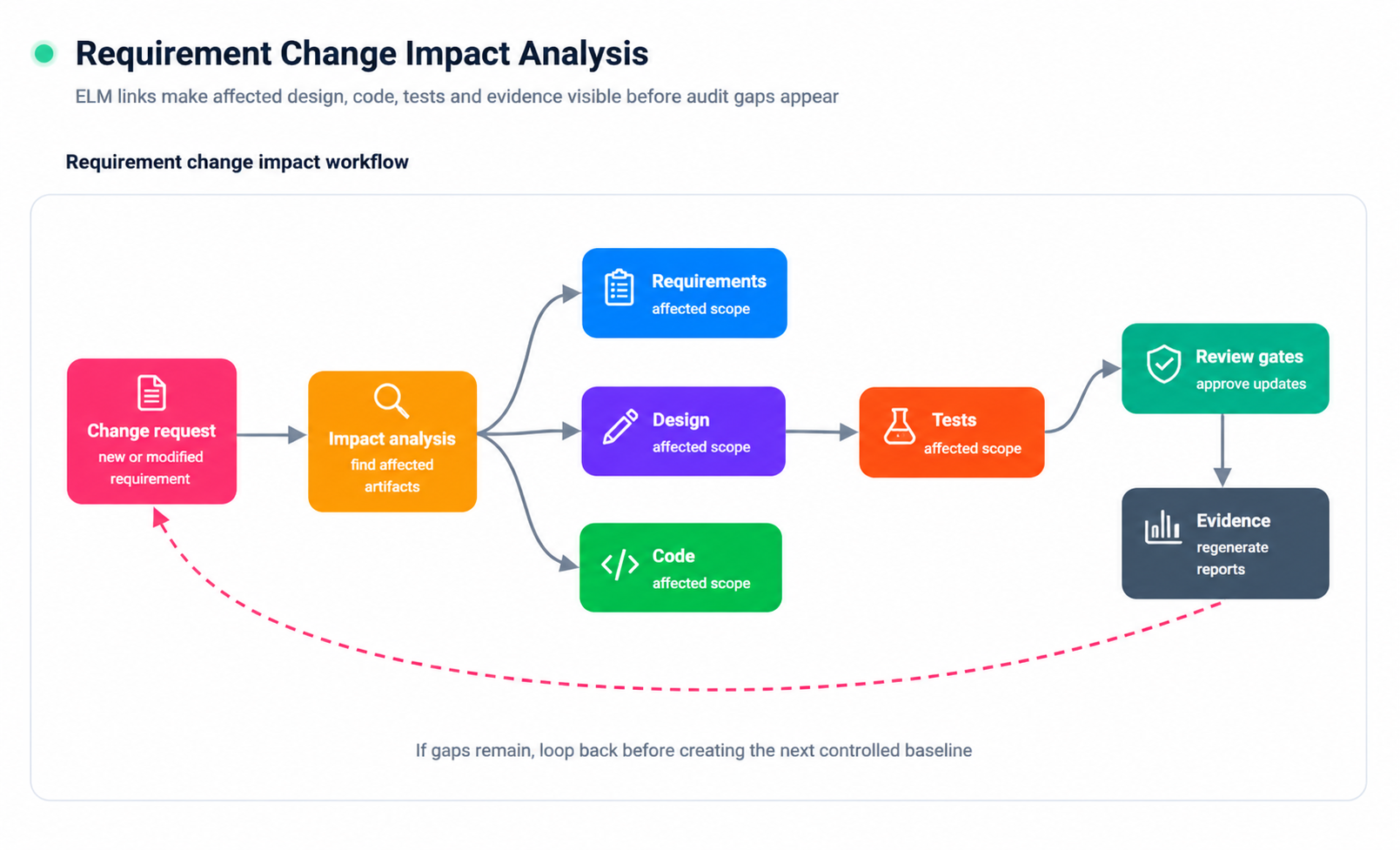
These relationships are valuable during audits, but they matter much earlier in the development process. Engineers can see the impact of a change before it creates hidden gaps, while reviewers can identify what still needs attention before certification evidence is assembled.
5. Supporting Iterative or Agile Development
DO-178C is often associated with sequential development, but the standard does not require one specific delivery model. What matters is that the team can maintain control, traceability, and objective evidence throughout the lifecycle.
IBM ELM can support iterative or agile development by helping teams manage work items, baselines, reviews, requirements, design, code, and verification activities in a controlled environment. This allows the project to move forward incrementally without losing the discipline required for DO-178C compliance.
For example, teams can track agile work items, create iterative baselines, expand requirements and design artifacts over time, and connect sprint-based verification activities to the right evidence. The result is a more flexible delivery approach that still preserves the traceability and audit readiness expected in safety-critical aviation software development.
📖 Learn more about ELM on our Aerospace & Defence Solutions page

Typical Challenges in DO-178C Development — and How ELM Helps
1. Requirement Drift and Inconsistent Design
As requirements evolve, teams struggle to keep design aligned.
ELM Solution:
Impact analysis shows what changes affect which design elements or code components, keeping everything synchronized.
2. Missing or Broken Traceability
Disconnected tools create gaps that auditors immediately flag.
ELM Solution:
Automated traceability links ensure that every requirement is connected to its design and code, with dashboards showing missing links.
3. Code Not Linked to Certification Evidence
Code reviews, coding standards, and justification are often scattered.
ELM Solution:
EWM ties work items, reviews, and change sets directly to DO-178C artifacts, creating a clean audit trail.
4. Manual Documentation Overload
Certification relies on documentation, and generating it manually is painful.
ELM Solution:
The suite automatically generates requirements reports, traceability matrices, design documentation, and change histories.

Best Practices for Using IBM ELM in DO-178C Development
● Plan your development workflow in advance, specifying requirements refinement, design approvals, and review criteria.
● Use strict versioning and baselines — especially when approaching major milestones.
● Automate as much traceability as possible — avoid creating links manually when tools can assist.
● Integrate modeling and design reviews — Rhapsody simulations catch errors long before testing.
● Require peer reviews for all code changes — EWM makes this mandatory in the workflow.
● Leverage dashboards to track coverage and ensure nothing is missed.
Not only do these practices make compliance easier, but they also help teams produce software that’s safer and more trustworthy.
How Softacus Helps with DO-178C Development in IBM ELM
IBM ELM provides the platform, but the real challenge is shaping it around the way a DO-178C project actually runs. That includes requirements structure, traceability rules, review flows, baselines, development change control, and the evidence teams need later.
Softacus helps aerospace and defence organizations configure IBM ELM so development work stays connected across requirements, design, implementation, and verification. The aim is to make the lifecycle easier to manage in practice, not just easier to describe in documents.
This is especially useful for teams that already use IBM ELM but need a setup that better supports certification-oriented engineering work.
A practical first step is a DO-178C development traceability review: Softacus can review how your current IBM ELM setup connects requirements, design, implementation and evidence, then identify where configuration changes would reduce manual reconstruction and compliance risk.

Conclusion
DO-178C software development depends on more than technical output. Teams need to keep requirements, design, code, reviews, and change history aligned as the project evolves.
IBM ELM supports this by connecting DOORS Next, Rhapsody, EWM, ETM and reporting capabilities into a shared lifecycle environment. When configured well, it helps teams reduce drift, control implementation work, understand change impact and prepare stronger evidence for the verification phase.
If your team already uses IBM ELM but still relies on spreadsheets, manual traceability checks or disconnected review evidence, that is usually a configuration and lifecycle-design problem — not just a tooling problem. Softacus can help assess the current setup and define a practical path toward controlled development traceability.
The next article in the series continues with software verification, where the development outputs created here become the basis for showing that the implemented software satisfies its requirements.
Continue the series
Sign up to our newsletter
Our Services
Our Extensions
More DO Content
Latest blog articles
Contact Us!
Softacus Services
We, in Softacus, are experts when it comes to consulting and service delivery of IBM software products and solutions in your business. We help our clients to improve visibility and transparency when licensing and managing commercial software, providing measurable value while increasing efficiency and accountability and we are providing services in different areas (see Softacus Services).
IBM ELM extensions developed by Softacus are free of charge for the customers who ordered IBM ELM licenses via Softacus or for the customers who ordered any of our services. If you are interested in any of our IBM ELM extensions, you found a bug or you have any enhancement request, please let us know at info@softacus.com.