The contemporary programs in development of complex products require teams of system engineers to provide more integrated products with faster delivery and without compromising the established quality standards and regulatory compliance. The interactions among the requirements baseline, model-based system engineering architecture, automated verification testing, and change management requests result in substantial bureaucratic and operational overhead in the digital thread lifecycle.
By combining the IBM Engineering Lifecycle Management (ELM) suite with AI Copilots and generative AI agents (hosted on platforms such as IBM watsonx), systems engineering teams can automate the execution of lifecycle processes.

Smart Requirements In IBM DOORS Next
Real-Time Quality Standards:
AI Copilots can improve requirement authoring quality standards through real-time quality scoring, INCOSE compliance enforcement, and automated summarization of lengthy customer specification documents.
Contextual Document Querying:
Using the natural language capabilities of AI agents, engineers can ask questions about complex customer requirements and product specification PDFs straight from a requirements module in DOORS Next.
Semantic Duplicate Detection:
These RAG-powered copilot widgets can also highlight semantic duplicates that might otherwise be overlooked during requirement reviews or authoring.
Domain-Specific Language Translation:
Teams can also utilize domain-specific large language models (LLMs) trained on technical English to translate local language requirements documents into canonical English requirements while preserving the intent and taxonomy.
Architecture Optimization in IBM Rhapsody
Anti-Pattern Analysis:
AI Copilots in IBM Rhapsody can analyze Block Definition Diagrams (BDD) and Internal Block Diagrams (IBD) for anti-patterns during the architecture definition and realization.
Model-to-Text Safety Audits:
Natural language processing capabilities allow Rhapsody to audit SysML-based architectural behavior against textual safety-critical constraints expressed in DOORS Next.
Pattern-Based Element Recommendations:
AI agents can recommend default SysML element relationships based on engineering patterns identified from previous product development programs.
Automated Interface Generation:
Generative AI models can analyze requirements-to-model associations and automatically propose the port interface definitions between related blocks in a SysML block definition diagram.
Architectural Refactoring:
AI Copilots could be used to recommend architectural refactoring of deeply nested SysML architecture packages.
Automated Testing In IBM ETM
Natural Language Test Creation:
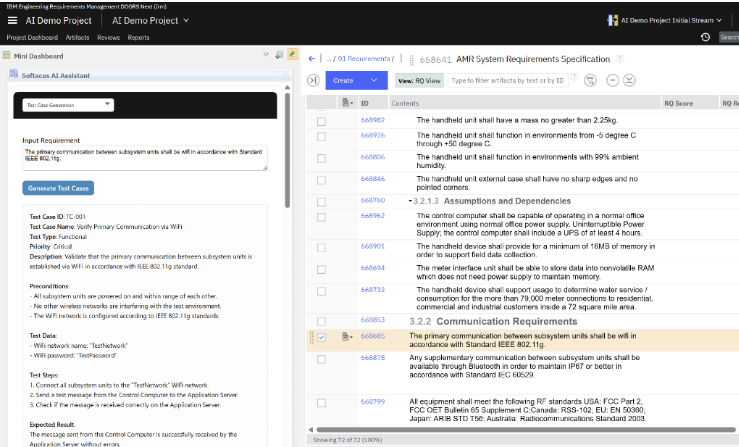
IBM Engineering Test Management (ETM) can harness the power of generative AI to create test cases from natural language requirements artifacts in DOORS Next.
Coverage Gap & Impact Updates:
Not only can AI Copilots analyze historical test execution data to surface incomplete test coverage before test qualification, but they can update test scripts when the linked requirements change.
Synthetic Data Optimization:
AI-generated test data can help optimize the execution of automated test scripts for complex embedded products.
Root-Cause & Failure Analysis:
When a test case fails during execution in IBM ETM, the Copilot can analyze the test execution stack trace, together with linked requirements, to determine potential failure modes.

Predictive Impact in IBM EWM
Smart Change Propagation:
When an Engineering Change Order (ECO) is raised in IBM Engineering Workflow Management (EWM), AI algorithms can study the Open Services for Lifecycle Collaboration (OSLC) associations to comprehend the possible consequences on successive verification and validation activities.
Financial & Schedule Forecasting:
Prior to approval of the ECO, AI Copilots could review all affected requirements, architecture models, software builds, and test scripts to estimate the financial and schedule impact of the proposed change.
Automated Task Ownership:
Machine learning algorithms can ingest past ECO execution data in EWM to recommend engineers likely to own the affected work items, accelerating assignment of change implementation tasks.
Sentiment & Delay Prediction:
By analyzing historical comments and commit frequency in EWM, AI algorithms can calculate change sentiment and predict potential schedule delays.
Automated Release Documentation:
AI Copilots can automatically generate release notes based on completed work items and resolved defects.
Automotive and Manufacturing Performance
40% Cycle Acceleration:
By enabling AI-augmented requirements reviews, engineering teams can realize a 40% acceleration in requirement iteration cycles.
35% Boost in Test Coverage:
AI-generated test scripts from DOORS Next requirements can boost test coverage by 35%, accelerating test planning and execution before hardware-in-the-loop (HIL) testing.
Streamlined Supplier Alignment:
Automated requirement validation can help accelerate the alignment of tiered supplier requirements through complex automotive supply chains.
Accelerated Functional Safety:
The AI-enhanced auditing of architectural and software safety constraints can accelerate ISO 26262 functional safety assessment across automotive and ASIL-D development programs.
Doubled ECO Processing Speed:
By enabling intelligent ECO processing using change impact prediction across variant-based vehicle architectures, Original Equipment Manufacturers (OEMs) could report a doubling of ECO processing speed.
Aerospace and Defense Performance
5X Faster Impact Analysis:
AI impact analysis of linked Rhapsody models and DOORS Next requirements helps accelerate change analysis by a factor of 5X over manual impact analysis.
Reduced Downstream Rework:
The AI detection of conflicting or unconnected requirements enables aerospace and defense engineering teams to uncover late-stage integration issues and avoid downstream hardware rework and re-qualification costs.
Focus on Core Safety:
By automating the audit of requirements-to-verification traceability, AI copilots can help keep engineering teams focused on the operational and safety-critical aspects of complex aerospace system development.
Accelerated Compliance Audits:
AI-enhanced auditing of the digital thread for critical aerospace systems (DO-178C, DO-254, ARP4754A/B) enables faster FAA/EASA regulatory audits.
Mitigated Supply Chain Delays:
By enabling the AI-assisted validation of sub-tier vendor specifications against system level requirements, defense contractors can help avoid supply chain delays and quality issues.
Strategic Benefits
The deployment of these AI capabilities results in several strategic benefits related to product development speed, quality, and regulatory compliance.
Faster Time-to-Market:
Since AI Copilots can take over document reviews, quality gates, and verification test planning, engineering organizations can realize quicker time-to-market for new products while reducing rework.
Continuous Audit Readiness:
The continuous auditing of OSLC traceability links as part of the digital thread ensures that no verification requirements are missed during certification audits – an especially crucial consideration for FAA/EASA/FDA-regulated products.
Reduced Burnout:
By reducing the need for engineers to manage large-scale quality gate reviews and document redlining, AI Copilots can reduce engineer fatigue and burnout related to large-scale product development programs.
Preservation of Institutional Knowledge:
AI Copilots can preserve institutional knowledge of product development best practices by identifying relevant lessons learned for similar product programs being developed by engineers at all career levels.
How Softacus Accelerates AI Adoption
The deployment of AI Copilots into an enterprise IBM ELM environment requires experience in configuring the toolchain and process to realize these capabilities. As an IBM Gold Business Partner, Softacus can deliver AI-specific capabilities:
Custom AI Extensions:
Extend DOORS Next, Rhapsody, ETM, and EWM with custom generative AI and Jazz widgets.
Configuration of Automated Workflow Rules:
Implement automated quality checks and custom attributes, FMEA risk algorithms, and review widgets in Jazz-based products.
Digital Thread Configuration Advice:
Provide guidance on linking legacy datasets, widgets, and AI-assisted products with auditable OSLC associations.
Regulatory Compliance Governance Design:
Guidance on structuring AI-assisted ELM environments around regulations (ARP4761, DO-178C, ISO 26262).
End-User Enablement Services:
Train engineering teams in the use of AI prompts and quality validation techniques in ELM products.
Conclusion
By combining IBM ELM products with AI Copilots and agents, organizations can transform their systems engineering practices from reactive maintenance into predictive management of the digital thread. Through the combination of IBM ELM governance and traceability features with the inferencing and prediction capabilities of modern AI algorithms, systems engineering teams can eliminate rework and accelerate the development of increasingly complex product systems.
Sign up to our newsletter
Our Services
Our Extensions
Latest blog articles
Contact Us!
Softacus Services
We, in Softacus, are experts when it comes to consulting and service delivery of IBM software products and solutions in your business. We help our clients to improve visibility and transparency when licensing and managing commercial software, providing measurable value while increasing efficiency and accountability and we are providing services in different areas (see Softacus Services).
IBM ELM extensions developed by Softacus are free of charge for the customers who ordered IBM ELM licenses via Softacus or for the customers who ordered any of our services. If you are interested in any of our IBM ELM extensions, you found a bug or you have any enhancement request, please let us know at info@softacus.com.